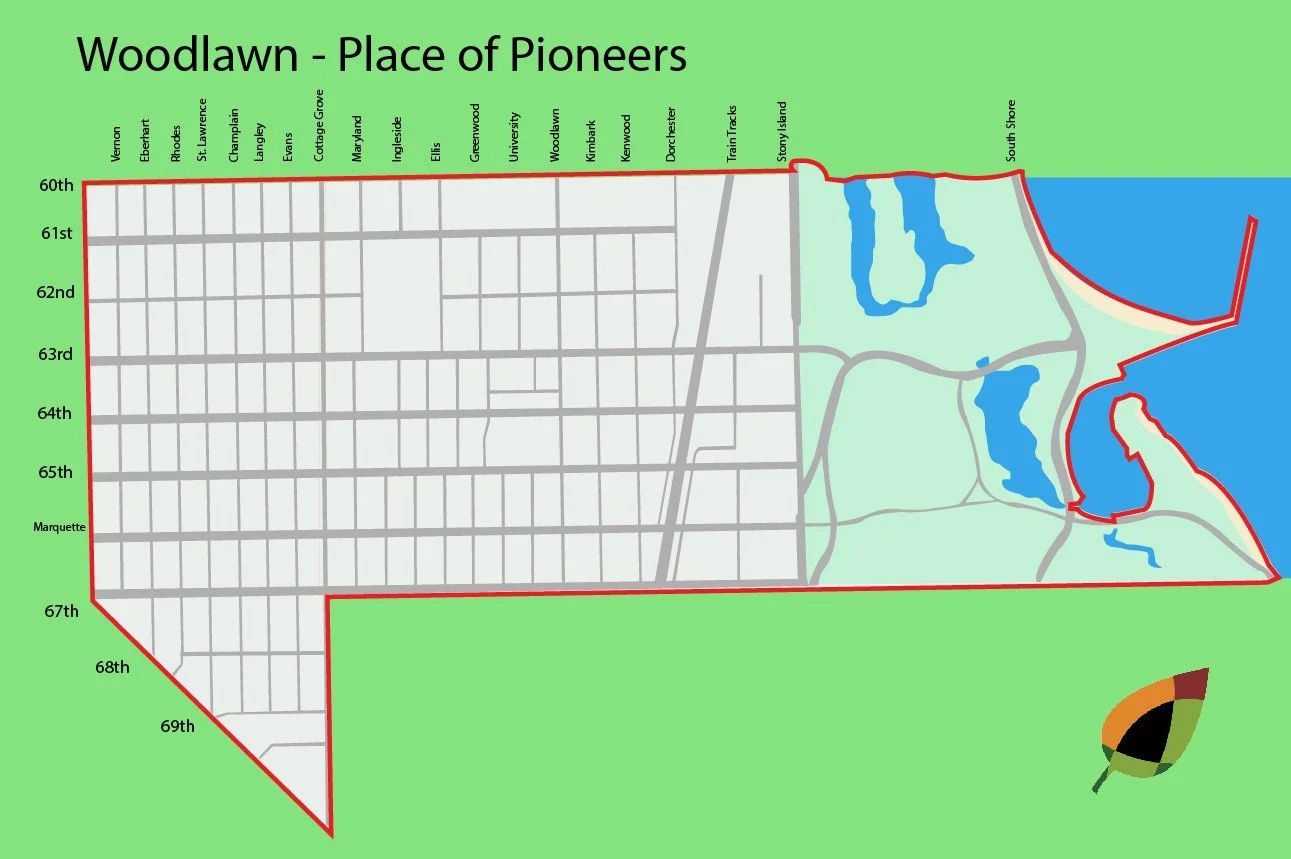
Woodlawn is one of the 77 community areas of Chicago in Illinois, United States. It is near the shore of Lake Michigan 8.5 miles (13.7 km) south of the Loop.
The community area is bounded by the lake to the east, 60th Street to the north, King Drive to the west and 67th Street to the south, and a small area that lies south of 67th Street between Cottage Grove Avenue and South Chicago Avenue. Locals sometimes divide the neighborhood along Cottage Grove into East and West Woodlawn.
Woodlawn contains a large portion of Jackson Park, including the site of the under-construction Barack Obama Presidential Center. The neighborhood is also home to a number of educational institutions: Hyde Park Career Academy, Mount Carmel High School, Chicago Theological Seminary, and the southern portion of the campus of the University of Chicago – including the Law School, the Harris School of Public Policy, the School of Social Service Administration, and the University of Chicago Press.
Demographics
Present-day Woodlawn is a predominantly African-American neighborhood. Per 2020 U.S. census data, the neighborhood's racial makeup is 79.8% Black, 10.1% White, 3.6% Asian, and 3.1% Hispanic, with an additional 3.1% belonging to two or more races. There are demographic differences within Woodlawn, however: West Woodlawn is about 95% African-American, while East Woodlawn is significantly more diverse. The median household income in the neighborhood is $32,189, with 31.17% of residents living below the poverty line.[2]
History
Racial transition
Historical population CensusPop.Note%± 193066,052—194071,6858.5%195080,69912.6%196081,2790.7%197053,820−33.8%198036,323−32.5%199027,473−24.4%200027,086−1.4%201025,983−4.1%202024,425−6.0%[1]
Up until 1948, Woodlawn was a middle class, white neighborhood, which grew out of the floods of workers and commerce from the 1893 World's Columbian Exposition. During the first half of the century, many University of Chicago professors lived in Woodlawn. With the Supreme Court ruling outlawing racially restrictive covenants in 1948, the combination of the expanding African American urban population, their limited housing options, and exploitive real estate maneuvers that divided up apartments into kitchenettes, Woodlawn began to have its first African American residents.[citation needed] Cayton and Drake described the anxieties and clashes that took place at the edge of the ghetto in Black Metropolis. The play A Raisin in the Sun is based on the experiences of author Lorraine Hansberry and her family, who were among the first to move in.
Like other communities bordering the ghetto, Woodlawn experienced intense bouts of white flight when the first African Americans moved into the neighborhood (especially the Washington Park Subdivision). Many institutions and people moved to the suburbs, a process that was facilitated by new federal housing loans. This combination of white flight from large apartments and high housing demand of the incoming African American population often proved lucrative for realtors, who routinely subdivided the vacated apartments. From this, buildings were over-filled with families. Absentee landlords seldom did much to maintain the buildings.[citation needed]
Others attempted to integrate this area but met with limited success. For example, the First Presbyterian Church (6400 South Kimbark Avenue) integrated in 1954 and, by the 1960s, had a markedly mixed character. However, older members often felt put out by the demographic and "cultural" changes that came with integration, and by the mid-1960s, the Church's finances and membership rates were in trouble. For better or for worse, there had been an across the board change in the community.
READ MORE